Resonance: The 350-Year-Old Physics Trick an Ill Man Noticed on His Wall, and the Watch That Finally Made It Reliable
In 1665, a bedridden Dutch scientist watched two clocks quietly agree with each other. It took watchmaking over three centuries, and one small manufacture in Biel, to turn that accident into something you can wear. This is the story of resonance and Armin Strom’s interpretation


There is a version ofthis watch's story that starts with springs and balance wheels. I want to startsomewhere else: with an ill man, alone in a room, staring at two clocks on awall.
THE ACCIDENT
In February 1665,Christiaan Huygens, the Dutch physicist who had invented the pendulum clock adecade earlier, was confined to bed with a minor illness. To pass the time, hewatched two of his pendulum clocks, hung from a shared wooden beam. What henoticed shouldn't have been possible. However, the two pendulums started,however out of step they began, within half an hour they always settled intoswinging in perfect opposition to one another: one went left as the other wentright, locked together with a precision neither clock could achieve alone.Huygens called it an “odd kind of sympathy.” Today we call it resonance.
He didn't have themathematics to fully explain it, differential calculus didn't exist yet, but hecorrectly suspected the clocks were communicating through the beam, exchangingvibrations too small to see. A century later, the French clockmaker AntideJanvier built clocks that deliberately exploited the effect. Abraham-LouisBreguet, having acquired Janvier's workshop, took the idea further still,building resonance clocks and at least one resonance pocket watch of his own.The principle was elegant and, on paper, extraordinary: two oscillators,correcting each other's errors in real time, producing a rate more stable thaneither could produce alone.
THE PROBLEM NOBODY COULD SOLVE
Here is what almostnobody tells you about resonance in watchmaking: for 350 years, it barelyworked. The effect Huygens observed in stationary pendulum clocks on a wall isfragile. Put two balance wheels on a wrist, subject them to the shocks androtations of daily life, and they drift apart far more easily than they fall backinto sync. Even F.P. Journe's celebrated Chronomètre à Résonance, the watchthat reintroduced the idea to modern collectors, requires its two balances tobe regulated to within about five seconds of each other before resonance willeven take hold — and real-world wear can knock them back out of it.
This was the actualproblem. Not achieving resonance once, in a laboratory, on a bench. Achievingit continuously, on a wrist, for years.
THE CLUTCH SPRING
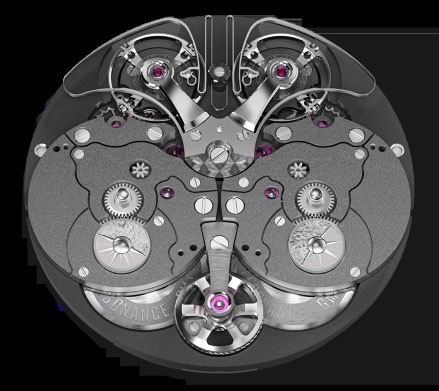
Claude Greisler, ArminStrom's technical director, spent close to three years chasing the answer, andfound it not by strengthening the coupling between the two balances but byrethinking it entirely. His solution, unveiled in 2016 and patented as theResonance Clutch Spring, is a long, sinuous steel spring that connects the twobalance springs directly, rather than relying on vibrations traveling looselythrough the case. Independently tested and confirmed by CSEM, the Swissresearch institute, the mechanism lets Armin Strom's two balances resynchronizeeven when their individual rates differ by as much as 250 seconds a day; amargin far more forgiving than Journe's, built specifically to survive theeveryday chaos of a moving wrist.
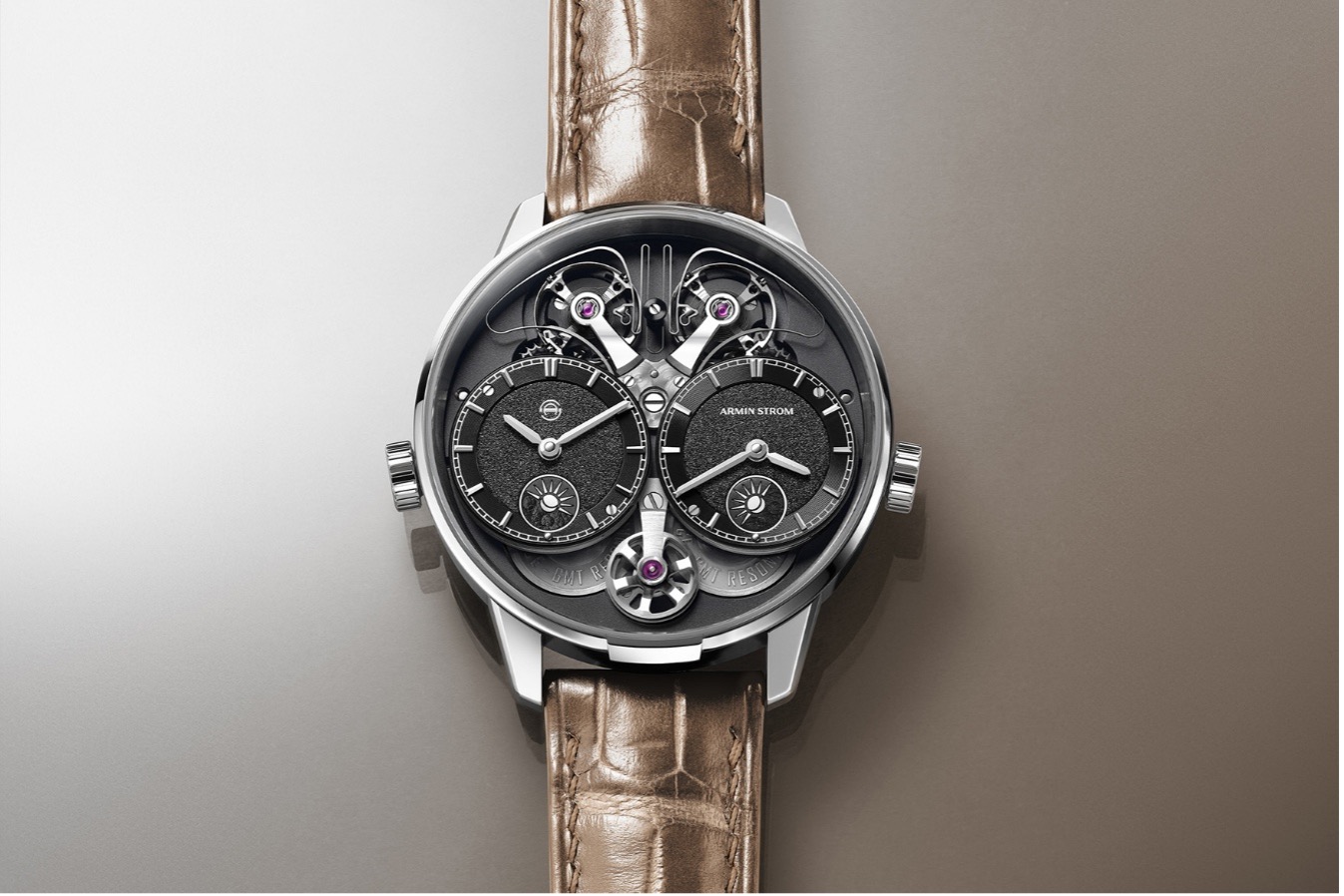
The Dual Time GMTResonance Manufacture Edition Black, Ref. ST25-DT.90, carries the currentgeneration of that same architecture, Calibre ARF22. Two balance wheels situnder twin arches at the top of the dial, rotating in opposite directions:clockwise and counterclockwise, visibly hunting for, and holding, agreement. Itis, quite literally, Huygens' wall beam, rebuilt in miniature, worn on a wristinstead of hung in a study.
THE PART THAT SURPRISED ME
Here is the detail thatmade me want to write this, rather than just admire it. In most GMT watches,the second time zone is decorative in the mechanical sense — a hand added ontop of a movement that was already keeping time perfectly well without it.
“The two resonating balances aren't a display sittingbeside the time. They are the two time zones, the same coupled system built tosolve a 350-year-old chronometric problem is, here, doing double duty as themechanism that tells you what time it is in two places at once.”
Each balance drives itsown independent hour and minute train, and because both are independentlyadjustable rather than jumping in fixed hourly increments, you can set agenuine fractional offset, something a standard single-hand GMT simply cannotdo.
THE VERDICT
I don't wear this watchbecause it is loud, or because it announces itself across a room. I wear itbecause every time I glance down, I am watching an argument between threecenturies of physics finally get resolved in real time. Huygens noticed thephenomenon. Breguet chased it. Journe brought it back into fashion. Armin Strom,working quietly out of Biel, is the first to make it actually reliable. That isnot a small claim. It is the whole story of this watch.
WATCH SPECIFICATIONS
Reference: Armin Strom Dual Time GMTResonance Manufacture Edition Black, Ref. ST25-DT.90
Case: 39mm, stainless steel, 9.05mmheight, 44.5mm lug-to-lug
Movement: Calibre ARF22, manual-winding,two independent regulating systems connected by a patented resonance clutchspring
Dial: Black grenage centres, blackazurage chapter rings, applied polished baton indexes, faceted rhodium hands,hand-engraved sun/moon day-night discs
Strap: Glossy taupe alligator,stainless steel pin buckle
Water resistance: 50metres
Price (approx.): CHF95,000 / approx. AED 431,500–432,000